
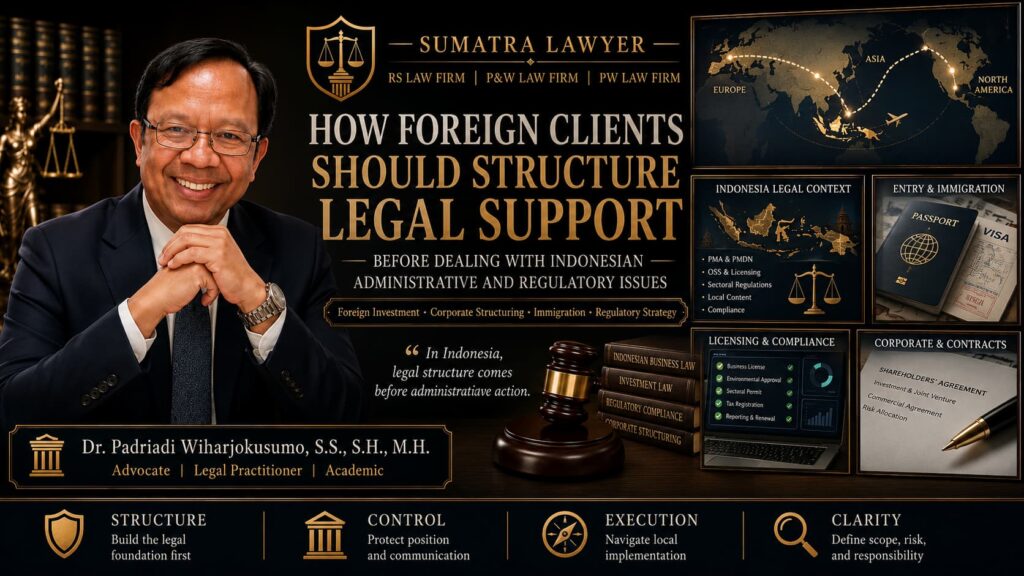
Sumatra Lawyer support is increasingly important for foreign clients dealing with Indonesian administrative and regulatory issues, especially when the matter involves immigration, business licensing, corporate administration, investment structuring, or government communication in Sumatra.
Based in Medan, North Sumatra, PW Law Firm approaches cross-border legal matters through a regional execution perspective. For foreign clients, this means working with Indonesian legal support that understands not only national regulations but also how administrative and regulatory issues are implemented in Sumatra.
Based in Medan, North Sumatra, PW Law Firm approaches cross-border legal matters through a regional execution perspective. For foreign clients, this means working with Indonesian legal support that understands not only national regulations but also how administrative and regulatory issues are implemented in Sumatra.
Foreign clients often approach Indonesian administrative and regulatory issues with one simple assumption: if the documents are complete, the process should move smoothly.
In theory, that assumption sounds reasonable.
In practice, Indonesia is not only a document-based jurisdiction. It is also an execution-based jurisdiction. Administrative outcomes are often shaped not only by written regulations but also by timing, institutional interpretation, local coordination, document consistency, and the ability to respond when the process does not move as expected.
This is particularly important for foreign clients dealing with immigration matters, business licensing, corporate administration, investment structuring, land-related issues, or regulatory communication with government offices in Indonesia.
Indonesia has developed digital systems to simplify administrative procedures. The Indonesian OSS RBA licensing system functions as an integrated electronic business licensing platform for business actors in Indonesia. The official OSS platform describes itself as an electronic integrated business licensing system designed to help business actors process licensing more efficiently.
However, digital access does not automatically eliminate legal risk. For foreign clients, the real question is not merely whether an application can be submitted online. The deeper question is whether the legal structure, supporting documents, business purpose, local execution, and regulatory pathway are aligned before the process begins.
This is why foreign clients should consider a foreign investment legal strategy in Indonesia before taking administrative action.
The First Mistake: Treating Indonesian Administrative Issues as Simple Paperwork
Many foreign clients treat Indonesian administrative matters as isolated technical tasks.
A visa issue is treated as “just immigration.”
A business license is treated as “just OSS.”
A corporate document is treated as “just notarial paperwork.”
A local permit is treated as “just administration.”
This approach is dangerous.
In Indonesia, administrative issues often sit at the intersection of several legal fields. An immigration issue may involve employment status, sponsorship, company structure, or business purpose. A licensing issue may involve KBLI classification, corporate capital structure, sectoral restrictions, tax consequences, and operational location.
For example, the Directorate General of Immigration provides official information on visas, visa on arrival, free visa subjects, and immigration stay permits for foreign nationals. The official Indonesia eVisa platform also allows users to explore visa services, apply for visas, and track application status online.
But for foreign clients, the existence of an official immigration platform does not mean every case is legally simple. The same visa or stay permit issue may carry different consequences depending on the client’s business activity, purpose of stay, contractual relationship, sponsor, and Indonesian counterpart.
That is why foreign clients should avoid entering the administrative process first and asking for legal advice later.
Legal support must come before execution.
The Second Mistake: Separating Licensing from Corporate Structure
A licensing issue in Indonesia is rarely only about licensing.
For foreign investors, business licensing must be read together with corporate structure, capital requirements, KBLI classification, shareholder composition, board authority, tax registration, operational address, and sectoral regulations.
This is where many foreign clients make a structural mistake. They assume that once a company exists, the licensing issue is already solved. In reality, the company may exist legally, but its structure may still be misaligned with the intended business activity.
This is especially relevant for PT PMA matters. Foreign clients should carefully assess PT PMA capital and licensing structure before filing or adjusting business licensing documents.
A wrong classification can create a delay.
A wrong capital assumption can create compliance risk.
A wrong business activity code can affect operational legality.
A wrong structure can create future disputes between foreign and local parties.
For this reason, legal support should not only ask, “What license do you need?”
The better question is:
“Is the legal structure behind the license already correct?”
The Third Mistake: Assuming Jakarta Alone Understands Indonesia
Another common mistake is assuming that Indonesian legal support must always be Jakarta-centered.
For some national-level matters, Jakarta is important. But Indonesia is not only Jakarta. Indonesia is a large archipelagic state with complex regional realities. Indonesia’s Ministry of Foreign Affairs has referred to Indonesia as the world’s largest archipelagic state, with more than 17,400 islands.
For foreign clients, this matters.
A regulatory issue in North Sumatra may not move in the same practical way as an issue in Jakarta, Bali, Batam, or Kalimantan. A business license connected to regional operations may require local coordination. A land or investment issue in Sumatra may involve local agencies, local counterparties, factual verification, and local institutional behavior.
This does not mean that local practice overrides national law.
It means that national law must be executed through local institutions.
Foreign clients dealing with Sumatra-based matters should therefore understand investment structuring and regulatory navigation in Sumatra before assuming that a national-level document is enough.
In practice, a lawyer must answer more than one question:
What does the regulation say?
How will the document be read locally?
Which institution may request clarification?
Are the facts consistent with the documents?
Is the foreign client exposed if the local counterpart gives a different explanation?
This is the difference between legal information and legal strategy.
The Fourth Mistake: Engaging Legal Support Too Late
Foreign clients often contact legal counsel only after a problem has already occurred.
By that time, the legal position may already be weakened.
The application may have been submitted incorrectly.
The wrong business classification may have been selected.
The communication trail may be unclear.
The Indonesian counterpart may have made representations that are difficult to verify.
The administrative office may already have formed an impression of the case.
In regulatory matters, timing matters.
A well-structured legal approach should begin before the first formal submission, before the first official meeting, and before the foreign client gives explanations that may later create inconsistencies.
This is especially important because an administrative issue can easily develop into a broader commercial or legal problem. A licensing delay may become a contractual dispute. A visa issue may reveal employment or sponsorship risk. A corporate document problem may affect investment control. A local administrative obstacle may later require business dispute strategy in Sumatra.
What begins as paperwork may become a dispute.
That is why legal support must be structured in phases.
Phase One: Legal Intake and Document Mapping
The first phase is not advocacy.
It is diagnosis.
Foreign clients should provide a clear summary of the issue, the relevant parties, the timeline, the documents already submitted, the government offices involved, and the expected outcome.
The purpose is to identify whether the matter is truly administrative or whether it has wider legal implications.
For example, a foreign client dealing with an Indonesian immigration issue may need to clarify:
Who is the sponsor?
What is the actual purpose of stay?
Is there any employment, consultancy, investment, or business activity involved?
Has any prior application been rejected or delayed?
Are there Indonesian counterparties involved?
Are there time-sensitive deadlines?
Without this intake process, legal support becomes reactive and incomplete.
The lawyer cannot structure a legal pathway if the factual foundation is unclear.
Phase Two: Regulatory Classification
The second phase is classification.
In Indonesian regulatory matters, classification often determines the entire pathway.
For business licensing, classification may involve identifying the correct business activity, risk level, sectoral requirements, and supporting documents under the integrated business licensing system.
For immigration, classification may involve identifying whether the client’s purpose fits a visitor visa, business visit, stay permit, investor arrangement, work-related activity, or another immigration pathway. The official eVisa system itself separates visa purposes into categories such as general, family or social, investment, business or government, professional or employment, study, and other purposes.
For corporate matters, classification may involve determining whether the issue concerns foreign investment, local partnership, nominee risk, shareholding, control, board authority, tax registration, or operational licensing.
The wrong classification creates the wrong strategy.
And the wrong strategy may create delay, rejection, or future legal exposure.
Phase Three: Local Execution Strategy
The third phase is local execution.
This is where many foreign clients fail.
They may have documents.
They may have translations.
They may have a general understanding of the regulation.
But they do not have a field strategy.
Local execution requires knowing how to communicate, which documents should be presented first, what should not be over-explained, how to preserve legal position, and how to prevent informal explanations from creating formal risk.
For foreign clients, this is especially important because cultural misunderstanding can easily become legal misunderstanding.
A foreign client may think they are being transparent.
A government officer may interpret the same explanation as inconsistent.
A local partner may simplify the issue.
A document may say one thing while the factual situation shows another.
This is why the lawyer’s role is not only to translate language.
The lawyer must translate legal risk into an execution strategy.
Phase Four: Written Scope, Fee, and Responsibility
Before work begins, foreign clients should insist on a written scope of work.
This protects both the client and the legal team.
A proper engagement structure should clarify:
what issue is being handled;
what documents will be reviewed;
what government office or administrative process is involved;
what work is included;
what work is excluded;
what fees apply at the initial stage;
what additional work may require separate approval;
what timeline is estimated but not guaranteed;
what information must be provided by the client.
This is particularly important in Indonesia because one administrative issue may expand into several legal problems.
A visa issue may expand into corporate compliance.
A licensing issue may expand into tax or employment questions.
A local dispute may expand into civil litigation or regulatory reporting.
A business inquiry may expand into investment structuring.
In certain situations, business or administrative problems may also carry reputational, regulatory, or criminal exposure. Foreign clients should understand that some business issues may develop into criminal exposure if facts, documents, payments, representations, or authority structures are not carefully controlled.
Without written scope, both sides may misunderstand the engagement.
For foreign clients, clarity is not bureaucracy.
Clarity is protection.
Why Cross-Border Clients Need Indonesian Legal Counsel Before Action
Foreign clients do not need Indonesian legal counsel merely to fill out forms.
They need Indonesian legal counsel to prevent the form from becoming a problem.
They need a lawyer who can see the structure behind the document, the regulatory implication behind the application, and the local execution risk behind the administrative process.
This is especially important when the issue involves foreign investors, foreign directors, foreign workers, regional operations, Indonesian counterparties, or government offices outside Jakarta.
A cross-border legal matter should not be handled as a casual administrative favor.
It should be treated as a structured legal engagement.
The key principle is simple:
Do not enter the Indonesian administrative system unstructured.
Structure first.
Classify the issue.
Map the documents.
Control the communication.
Execute locally.
Document every step.
Conclusion: In Indonesia, Legal Structure Comes Before Administrative Action
Foreign clients dealing with Indonesian administrative and regulatory issues should avoid the temptation to move too quickly.
Indonesia has official digital systems, immigration platforms, and business licensing channels. These are important developments. But legal risk does not disappear simply because a system is online.
For foreign clients, the real challenge is not only access to the system.
The real challenge is building the right legal structure before entering the system.
Administrative success in Indonesia depends on more than paperwork.
It depends on structure, control, and execution.
Foreign clients who understand this will approach Indonesian regulatory matters differently. They will not ask only:
“What document do I need?”
They will ask the better question:
“Is our legal position properly structured before we take the next step?”
That question may prevent delay, misunderstanding, rejection, dispute, and unnecessary legal exposure.
And in cross-border legal work, prevention is often more valuable than correction.
About the Author
Dr. Padriadi Wiharjokusumo is an Indonesian legal practitioner and academic based in Medan, North Sumatra. His work focuses on foreign investment, corporate legal strategy, cross-border advisory, regulatory issues, and dispute strategy in Indonesia, particularly in Sumatra-based matters.
Academic Disclaimer
This article is provided for general legal and academic discussion only. It does not constitute legal advice and should not be relied upon as a substitute for specific legal consultation. Foreign clients dealing with Indonesian administrative, immigration, corporate, investment, or regulatory matters should seek tailored legal advice based on their specific facts, documents, timeline, and legal position.
If you are a foreign client facing administrative or regulatory issues in Indonesia, you may contact PW Law Firm via WhatsApp for an initial legal assessment.
WhatsApp: +62 812 6327 8064