
Joint venture deadlocks in Indonesia can become serious legal risks for foreign investors when shareholder disagreement affects control, permits, assets, documents, and project execution.
Foreign investors entering Indonesia often begin with optimism.
A local partner appears cooperative.
The business opportunity looks promising.
The company structure seems sufficient.
The initial documents appear complete.
But when commercial pressure begins, many joint ventures face a different reality.
Decisions become delayed. Shareholders disagree. Directors lose alignment. Access to company documents becomes difficult. Local permits, land assets, operational licenses, suppliers, employees, and bank accounts may suddenly become points of leverage.
In many Indonesian joint ventures, the real risk is not simply disagreement between shareholders. The deeper risk is loss of control over decisions, documents, assets, permits, and execution.
This is when a joint venture disagreement becomes something more serious: a joint venture deadlock.
For foreign investors in Indonesia, especially in asset-intensive regions such as Sumatra, a deadlock is not merely a commercial inconvenience. It can become a structural legal risk affecting control, continuity, investment protection, regulatory compliance, and dispute strategy.
This is why foreign investment legal strategy must begin before conflict appears.
For investors who have just completed or are planning a PMA structure, this article continues the discussion from our previous analysis on PMA setup in Sumatra. Company formation is only the beginning. The real test is whether the structure can survive disagreement, pressure, and operational disruption.
Why Joint Venture Deadlocks Matter in Indonesia
A joint venture deadlock occurs when shareholders, directors, or key decision-makers can no longer make essential business decisions because of disagreement, blocking positions, or loss of trust.
In Indonesia, this risk is particularly important because a company does not operate only through contracts. It also depends on corporate approvals, licensing systems, local administrative processes, land documents, tax compliance, banking authority, employment management, and interaction with local stakeholders.
Indonesian limited liability companies are generally governed by Law No. 40 of 2007 on Limited Liability Companies, which regulates key corporate organs such as shareholders, directors, and commissioners. The official Indonesian legal database also notes that this law has been amended by later legislation, including the Job Creation framework.
For foreign investors, this means a joint venture must be structured not only around ownership percentages but also around practical control.
The most important question is not always:
Who owns the shares?
The stronger question is:
Who controls the decisions when the relationship breaks down?
Deadlock Is Usually a Structural Problem
Many investors assume that joint venture deadlocks happen because one party becomes difficult, emotional, or uncooperative.
That may be true on the surface.
But in legal strategy, deadlock is often a symptom of deeper structural weakness.
A poorly structured joint venture may fail to answer critical questions:
Who has the authority to approve major transactions?
Who controls the bank account?
Who appoints and removes directors?
Who controls access to company documents?
Who holds the operational licenses?
Who manages local government communication?
Who controls the land, factory, plantation, warehouse, hotel, or mining site?
What happens if one party refuses to sign?
What happens if the company cannot hold a valid shareholder meeting?
What happens if one party uses regulatory pressure as leverage?
If these questions are not addressed before the investment begins, the foreign investor may later discover that legal ownership does not automatically mean effective control.
This is one of the most common mistakes in foreign investment structuring in Indonesia.
The Local Partner Risk
Local partners are often important in Indonesia.
They may provide market knowledge, land access, administrative familiarity, community relationships, sector experience, or operational support. In certain business sectors, foreign ownership limitations may also require careful structuring around applicable investment rules.
A strong local partner can be a strategic advantage.
The issue is not local partnership itself. The issue is whether the partnership is governed by clear legal architecture.
A foreign investor should not rely only on trust, friendship, verbal assurances, or early-stage alignment. These may help start a business relationship, but they are not enough to protect capital when conflict appears.
The legal documents must clearly define rights, obligations, control mechanisms, reserved matters, deadlock resolution procedures, exit rights, confidentiality, non-compete duties, dispute resolution, and access to company information.
This is not distrust.
It is responsible governance.
A joint venture is not merely a contractual arrangement. It is also a test of responsibility, trust, and ethical control. When legal structure fails to reflect these values, commercial cooperation can quickly turn into institutional conflict.
Key Legal Triggers in Indonesian Joint Ventures
Foreign investors should pay attention to several common triggers of joint venture deadlocks in Indonesia.
1. Equal Shareholding Without Deadlock Mechanism
A 50:50 structure may look fair, but it can be dangerous if there is no mechanism to resolve disagreement.
Equal ownership can create paralysis when both parties have veto power but no agreed solution.
Without a proper deadlock clause, the company may be unable to approve budgets, appoint directors, sign contracts, sell assets, obtain financing, or continue operations.
2. Reserved Matters Without Clear Thresholds
Reserved matters are decisions that require special approval from shareholders or certain parties.
They may include:
capital increases;
major asset sales;
bank loans;
appointment of directors;
related-party transactions;
business expansion;
litigation decisions;
licensing actions;
dividend distribution;
changes to articles of association.
Reserved matters are useful, but if drafted too broadly, they can create excessive veto rights. If drafted too narrowly, they may fail to protect the investor.
The legal strategy is to balance protection with operational flexibility.
3. Director Control Without Shareholder Protection
Some foreign investors focus heavily on share ownership but overlook director control.
In Indonesian companies, directors play a central role in managing daily operations. If the wrong party controls the board of directors, the investor may face difficulty accessing documents, approving payments, managing employees, or implementing business decisions.
A strong joint venture structure must align shareholder control, director appointment rights, commissioner oversight, and internal approval procedures.
4. Weak Access to Documents and Financial Information
Deadlocks often become dangerous when one party loses visibility.
If the foreign investor cannot access financial records, tax documents, licensing correspondence, asset documents, bank statements, employment records, or corporate approvals, the dispute becomes harder to manage.
Information control can become a weapon.
This is why the joint venture agreement must include clear rights to inspect books, receive reports, access corporate documents, conduct audits, and obtain copies of key legal records.
5. Asset Dependency
In Sumatra, many foreign investment projects are asset-intensive.
They may involve land, plantations, palm oil facilities, warehouses, ports, factories, hotels, mining assets, forestry-linked operations, or tourism projects.
The risk is not only inside the company.
The real leverage may be outside the company:
land certificates;
HGU or HGB rights;
location permits;
environmental approvals;
community arrangements;
supplier contracts;
access roads;
operational sites;
local workforce control.
If the joint venture company does not clearly control the asset, the investor may own shares in a company that cannot effectively operate.
This is where legal structure and local execution must be tested together.
Why Sumatra Requires Execution Awareness
Sumatra offers significant opportunities for foreign investors.
It has strategic sectors such as plantations, natural resources, logistics, ports, tourism, hospitality, property, infrastructure, and manufacturing. But investment risk in Sumatra is rarely limited to what appears in the corporate documents.
Foreign investors must understand local execution realities.
A dispute in Jakarta may be handled primarily through formal corporate channels.
But a dispute in an asset-heavy regional project may involve land offices, local government agencies, village-level issues, operational employees, suppliers, police reports, administrative correspondence, and physical access to assets.
This does not mean investors should avoid Sumatra.
It means they must structure investments with regional legal awareness from the beginning.
For broader legal advisory support in the region, see our page on foreign investment legal strategy in Sumatra and our legal insights on strategic legal advisory support in Indonesia.
Dispute Resolution Clauses Are Not Enough
Many joint venture agreements contain arbitration clauses, court jurisdiction clauses, or mediation provisions.
These are important.
But they are not enough.
A dispute resolution clause only tells the parties where and how the dispute may be resolved. It does not automatically protect the investor during the months or years before a final decision.
Before arbitration or litigation produces a result, the investor may still face urgent issues:
Who controls the bank account?
Who signs urgent regulatory filings?
Who pays employees?
Who keeps the license active?
Who controls the asset site?
Who communicates with authorities?
Who protects the documents?
Who prevents asset dissipation?
A strong legal strategy must therefore include both dispute resolution and interim control protection.
For cross-border investors, arbitration may be useful, but enforcement and local implementation in Indonesia require practical legal planning. Indonesia’s arbitration framework is shaped by Law No. 30 of 1999, and recent developments have also addressed the definition and treatment of international arbitration awards in Indonesia.
The point is simple:
Dispute resolution must be connected to execution.
Prevention Strategy: Structure Before Conflict
Foreign investors should not wait until the relationship breaks down before seeking legal advice.
The better approach is preventive legal structuring.
Before entering a joint venture in Indonesia, investors should review:
the articles of association;
shareholder agreement;
joint venture agreement;
director and commissioner appointment rights;
reserved matters;
voting thresholds;
deadlock clauses;
put and call options;
exit mechanisms;
audit rights;
bank mandate;
asset ownership;
license holder identity;
land use structure;
dispute resolution clause;
emergency control procedures;
governing law;
language of documents;
tax and regulatory exposure.
This review is not merely technical.
It determines whether the investment has legal resilience.
A foreign investor should ask:
Can the company still function if trust disappears?
Can the investor still access documents if the local partner becomes hostile?
Can the business continue operating if one party blocks decisions?
Can assets be protected before the dispute reaches court or arbitration?
Can the structure survive regulatory pressure?
If the answer is no, the investment may already be vulnerable.
The Structure–Control–Execution Framework
At PW Law Firm, we often assess foreign investment risk through three connected questions.
Structure
Does the legal architecture properly reflect the investor’s commercial objectives?
This includes company formation, shareholder rights, contractual obligations, ownership structure, licensing, land rights, security arrangements, and dispute mechanisms.
Control
Who has practical decision-making authority when pressure appears?
This includes voting rights, director control, bank authority, document access, operational control, regulatory communication, and asset management.
Execution
Can the legal strategy work in the real environment where the business operates?
This includes local administrative behavior, regional regulatory practice, court access, enforcement strategy, stakeholder pressure, and physical control over assets.
Foreign investors often focus on structure.
But in Indonesia, especially in Sumatra, a structure without control can fail. Control without execution can also fail.
The strongest legal strategy must integrate all three.
This approach is also consistent with broader principles of corporate governance in Indonesia, where transparency, accountability, checks and balances, and responsible corporate conduct remain important references for company resilience.
Practical Red Flags for Foreign Investors
A foreign investor should be cautious when:
the local partner insists on informal arrangements;
the joint venture agreement is too simple;
the articles of association do not reflect the commercial agreement;
the company relies on assets not legally controlled by the company;
bank authority is concentrated in one party;
corporate documents are held only by the local partner;
licenses are connected to another entity;
there is no deadlock clause;
there is no clear exit mechanism;
reserved matters are unclear;
the foreign investor cannot conduct independent legal due diligence;
dispute resolution is treated as a standard template;
local administrative risks are ignored.
These red flags do not always mean the project is bad.
But they do mean the legal structure must be strengthened before capital is exposed.
Legal Strategy When a Deadlock Has Already Occurred
If a joint venture deadlock has already happened, the investor should avoid emotional or impulsive responses.
The first step is to preserve evidence and understand the legal position.
This may include reviewing:
company deed and amendments;
articles of association;
shareholder resolutions;
director appointments;
board meeting minutes;
bank mandates;
contracts;
licenses;
land documents;
tax filings;
correspondence;
WhatsApp messages;
emails;
financial records;
asset control documents.
The second step is to identify leverage.
Not all leverage is legal. Some leverage may be operational, regulatory, financial, reputational, or administrative.
The third step is to design a staged response.
This may include negotiation, formal notice, shareholder meeting strategy, director-level action, document demand, audit request, regulatory correspondence, civil claim, criminal risk assessment, arbitration preparation, or settlement architecture.
The goal is not merely to fight.
The goal is to regain strategic control.
Why Legal Advice Must Be Local and Strategic
Foreign investment disputes in Indonesia cannot be handled only from a distance.
International counsel may understand transaction documents. But local legal strategy is needed to understand how corporate, administrative, regional, and enforcement realities interact.
This is especially true in Sumatra.
A joint venture deadlock involving land, plantations, mining, logistics, tourism, or local permits may require more than a contractual opinion. It may require a coordinated legal response involving corporate law, administrative law, land law, dispute strategy, and local execution.
That is why foreign investors should not treat local counsel as a formality.
Local counsel should be involved early, before the structure is signed, before the documents are finalized, and before the capital is fully exposed.
Conclusion: A Joint Venture Must Survive Pressure
A joint venture is successful not only when the parties agree at the beginning.
It is successful when the legal structure can survive disagreement.
For foreign investors in Indonesia, the danger is not only that a local partner may disagree. The greater danger is that the investment structure may not contain the tools needed to manage disagreement.
In Sumatra, where many investments involve land, permits, local authorities, physical assets, and operational dependency, joint venture deadlocks must be anticipated from the beginning.
The real question is not simply:
Can we form the company?
The stronger question is:
Can our legal structure survive when the relationship breaks down?
Foreign investors who ask that question early are better positioned to protect capital, maintain control, and execute strategy in Indonesia.
Call to Action
Foreign investors, companies, and decision-makers facing joint venture risks, shareholder disputes, local partner issues, or investment structuring concerns in Indonesia may contact PW Law Firm for a preliminary legal assessment.
WhatsApp: +62 812 6327 8064
Website: PW Law Firm Medan
Please prepare a summary of the matter, relevant documents, company structure, shareholder arrangement, and key timeline before requesting an assessment.

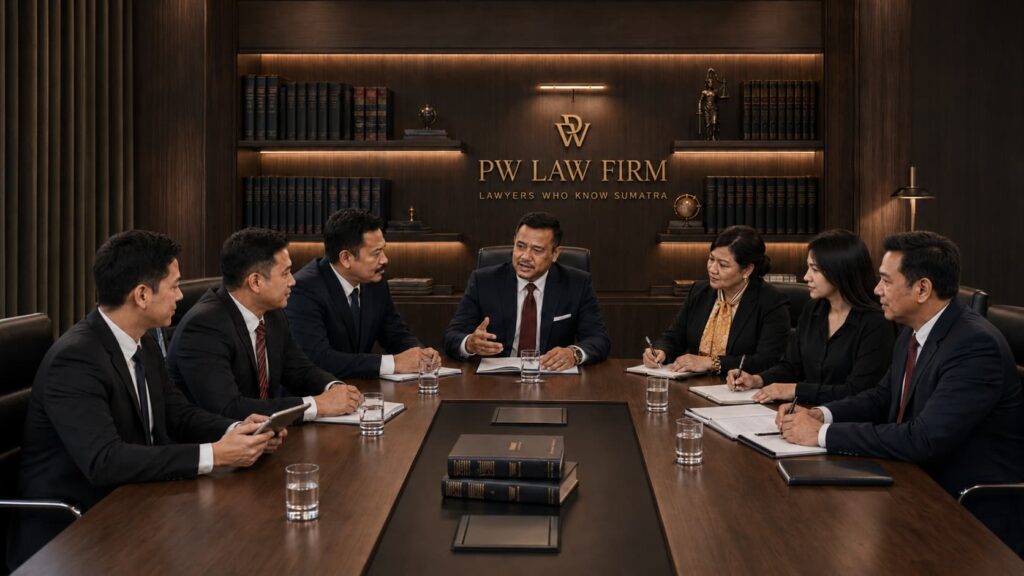
PW Law Firm legal team reviewing investment structure and project execution risks in an Indonesian industrial estate. Joint venture deadlocks in Sumatra require clear structure, control mechanisms, and practical legal strategy before conflict begins.
Academic & Professional Disclaimer
This article is provided for general legal information and educational purposes only. It does not constitute legal advice, legal opinion, or a lawyer-client relationship. Foreign investors and companies should obtain specific legal advice based on their documents, corporate structure, sector, location, licensing position, and factual circumstances before making legal or business decisions in Indonesia.
Author Box
Dr. Padriadi Wiharjokusumo is an Indonesian legal practitioner and academic based in Medan, North Sumatra. His work focuses on foreign investment strategy, corporate law, dispute resolution, regulatory risk, and asset-intensive business sectors in Sumatra and Indonesia. Through PW Law Firm, he develops legal insights for foreign investors, companies, and decision-makers seeking structured legal support in Indonesia.