
Table of Contents
- Why HGU and HGB Matter for Foreign-Backed Projects
- Understanding HGU, HGB, and Other Land Use Rights
- Foreign Ownership Limits and Legal Control
- Nominee Risk and Unsafe Land Structures
- Structuring Land Rights for Plantations, Property, and Industrial Projects
- How PW Law Firm Assists Foreign-Backed Projects in Sumatra
- Conclusion
- Professional Inquiry
- Academic and Professional Disclaimer
- Author
Why HGU and HGB Matter for Foreign-Backed Projects
HGU and HGB in Indonesia are central legal instruments for companies, investors, and foreign-backed projects that require secure land use rights for long-term operations.
In Sumatra, land is often connected to plantations, industrial facilities, warehouses, logistics assets, property development, renewable energy projects, and other asset-intensive businesses. For foreign investors, the issue is not only whether land can be used. The more important question is whether the land structure is legally safe, commercially practical, and defensible under Indonesian law.
A foreign-backed project may involve a foreign shareholder, a PT PMA, an Indonesian operating company, a local partner, a concession holder, or a project company. Each structure may create different consequences for land control, licensing, financing, corporate governance, and dispute risk.
This is why land rights should not be treated as a technical issue at the end of the transaction. They should be reviewed from the beginning of the investment structure.
PW Law Firm assists business clients through its broader corporate legal services and foreign investment legal advisory framework for investors operating in Medan, North Sumatra, and wider Sumatra.
Understanding HGU, HGB, and Other Land Use Rights
In Indonesian land law, different land rights serve different purposes.
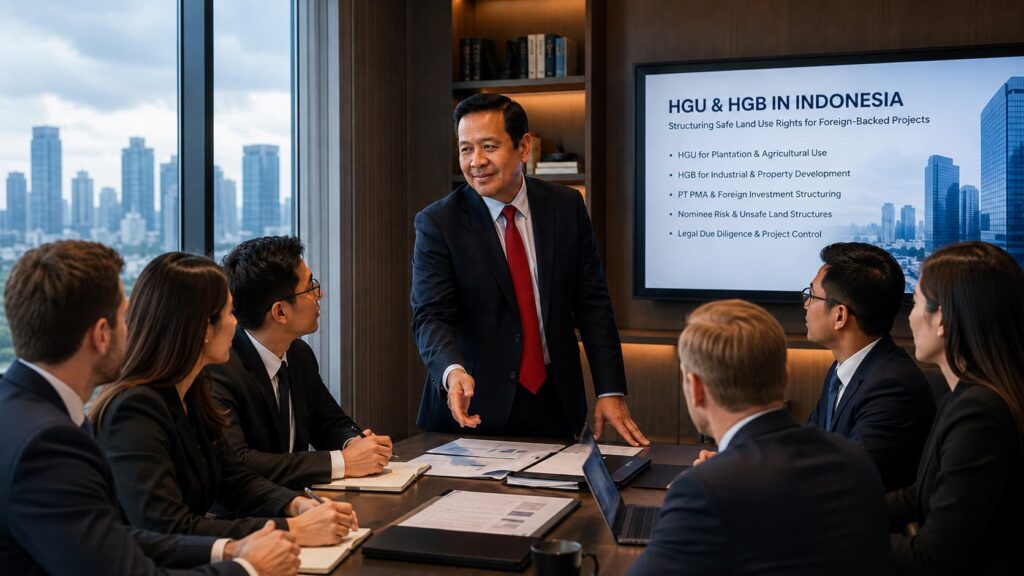
HGU, or Hak Guna Usaha, is generally relevant for agricultural, plantation, and land cultivation activities. It is often associated with plantation businesses and other large-scale agricultural operations.
HGB, or Hak Guna Bangunan, is generally relevant for the right to construct and own buildings on land. It is commonly used for industrial facilities, commercial buildings, warehouses, offices, property developments, and similar business assets.
Other land rights may also become relevant depending on the project, including Hak Pakai and certain rights held by Indonesian individuals or entities. However, foreign-backed projects must be structured carefully because Indonesian land law places important limits on direct foreign ownership and control over land.
The practical point is simple: the project’s land right must match the project’s business purpose.
A plantation project should not be structured like an ordinary property transaction. A warehouse project should not ignore building rights and licensing alignment. A mining-related support facility should not rely only on commercial arrangements without checking land status, access, spatial planning, and environmental compliance.
Foreign Ownership Limits and Legal Control
Foreign investors cannot treat Indonesian land as if it were land in a fully liberal ownership regime.
Land control in Indonesia is closely connected to nationality, corporate structure, licensing, and the type of land right involved. Foreign-backed projects must therefore distinguish between ownership, use, control, operational access, contractual rights, financing security, and corporate decision-making power.
For foreign investors, legal control does not always mean direct personal ownership of land. In many cases, control must be achieved through a properly structured Indonesian legal entity, valid land rights, enforceable agreements, regulatory compliance, and clear governance mechanisms.
This is where many investment risks begin. A foreign investor may focus on commercial control but ignore land law restrictions. A local partner may hold land documents without adequate corporate safeguards. A project company may operate on land whose title does not match the intended business use. An agreement may appear commercially strong but remain weak when tested against land administration, licensing, or litigation.
Safe structuring must connect land rights with corporate structure, investment licensing, contractual protection, and dispute strategy.
Nominee Risk and Unsafe Land Structures
Nominee arrangements remain one of the most dangerous risks in foreign-backed land projects.
A nominee structure may appear convenient because it allows a foreign investor to use an Indonesian person or entity to hold land on their behalf. However, this type of arrangement can create serious legal, commercial, and litigation risks.
The risk is not only regulatory. It is also practical.
If the relationship breaks down, the foreign investor may face difficulty proving control. If the nominee refuses cooperation, the project may be blocked. If the land becomes disputed, the investor may have limited standing. If authorities or courts examine the structure, the arrangement may be challenged as inconsistent with the legal framework.
For asset-intensive projects in Sumatra, nominee risk can become even more serious because land assets may involve large areas, local communities, operational infrastructure, permits, financing, and long-term business commitments.
A safer approach is to build lawful control through proper corporate structuring, clear land rights, strong agreements, documented authority, and early legal due diligence.
Structuring Land Rights for Plantations, Property, and Industrial Projects
Different projects require different land structures.
For plantation and agricultural projects, HGU may be central. Investors should review the validity period, land area, boundary records, plantation licensing, environmental documents, community issues, and any overlapping claims.
For property and industrial projects, HGB may become more relevant. Investors should review whether the land supports construction, business operation, building ownership, financing, access, zoning, and future transferability.
For logistics, energy, mining-related facilities, or mixed-use assets, the legal review may need to combine land status, corporate licensing, environmental compliance, access rights, operational control, and contractual protection.
Land structuring should also consider future events. Can the land right be extended? Can the project be financed? Can the asset be transferred? Can the company defend the title if challenged? Can the land use survive regulatory review or local objection?
These questions matter because land is not only an entry requirement. It is part of the project’s long-term legal foundation.
A proper structure should support not only acquisition, but also operation, financing, compliance, dispute prevention, and exit strategy.
How PW Law Firm Assists Foreign-Backed Projects in Sumatra
PW Law Firm assists companies, foreign investors, PT PMA structures, local partners, and corporate decision-makers in assessing land rights and legal structure for foreign-backed projects in Sumatra.
Our assistance may include preliminary legal assessment, HGU/HGB review, land title due diligence, transaction-structure analysis, nominee-risk assessment, investment-licensing review, contract review, dispute-risk mapping, and coordination with relevant authorities where necessary.
For foreign-backed projects, land rights should be reviewed together with corporate control, investment structure, operational purpose, financing requirements, and future dispute exposure.
This is particularly important in Sumatra, where land issues may involve plantation history, local communities, old documents, overlapping claims, concession boundaries, and practical field control.
A safe land structure is not only about holding documents. It is about ensuring that the project can operate, grow, defend its rights, and remain compliant over time.
Conclusion
HGU and HGB in Indonesia are not merely administrative labels.
They are part of the legal architecture of foreign-backed projects.
For investors, plantation companies, property developers, industrial operators, and project sponsors in Sumatra, the central question is not only which land right is available.
The real question is whether the land right is properly structured, legally compliant, commercially useful, and strong enough to support long-term control.
A weak land structure can create future disputes, financing problems, operational disruption, regulatory exposure, and loss of investor confidence. A strong land structure can help protect the project from unnecessary risk.
Professional legal advice should therefore connect land law, corporate structure, investment licensing, contracts, field reality, and dispute strategy.
For foreign-backed projects in Sumatra, safe land control requires more than access to land. It requires structure, control, and execution.
Professional Inquiry
For companies seeking a Medan law firm for HGU and HGB in Indonesia, foreign-backed land projects, plantation land rights, property development, industrial land structuring, PT PMA land issues, or nominee-risk assessment in Sumatra, PW Law Firm provides professional legal assessment based on the specific facts and documents.
To support an initial review, please prepare a brief chronology, land certificates, HGU/HGB documents, company structure, shareholder information, investment licensing documents, project location, intended land use, existing agreements, and any known dispute or administrative issue.
Rest assured, all information provided during this preliminary stage will be treated with the utmost professional confidentiality.
WhatsApp: +62 812 6327 8064
Email: pwlawfirmmedan@gmail.com
Academic and Professional Disclaimer
This article is intended for general legal and educational discussion only. It does not constitute specific legal advice, a formal legal opinion, or the establishment of an attorney-client relationship. Each land rights and foreign investment matter should be assessed based on its own facts, documents, parties, land status, corporate structure, licensing position, project location, administrative records, and applicable Indonesian law.
Author
Dr. Padriadi Wiharjokusumo is a lawyer, lecturer, and international legal strategist advising companies, investors, and decision-makers in Medan, North Sumatra, and wider Sumatra on HGU/HGB issues, foreign-backed land projects, corporate structuring, investment risk, plantation and property matters, and dispute-related legal strategy.
Medan law firm advising companies and foreign-backed projects on HGU, HGB, land rights, and investment structure in Sumatra

LAWYERS WHO KNOW SUMATRA
Related Topics
PWLawFirm, PWLawFirmMedan, LawyerMedan, LawyerSumatra, PengacaraMedan, CorporateLawyerMedan, HGUIndonesia, HGBIndonesia, IndonesianLandLaw, ForeignInvestmentIndonesia, PT PMA Indonesia, PlantationLawIndonesia, PropertyLawIndonesia, LandRightsIndonesia, InvestmentStructuring, NomineeRiskIndonesia, BusinessRiskIndonesia, CorporateLegalAdvisor, HukumPertanahan, KonsultanHukumMedan