
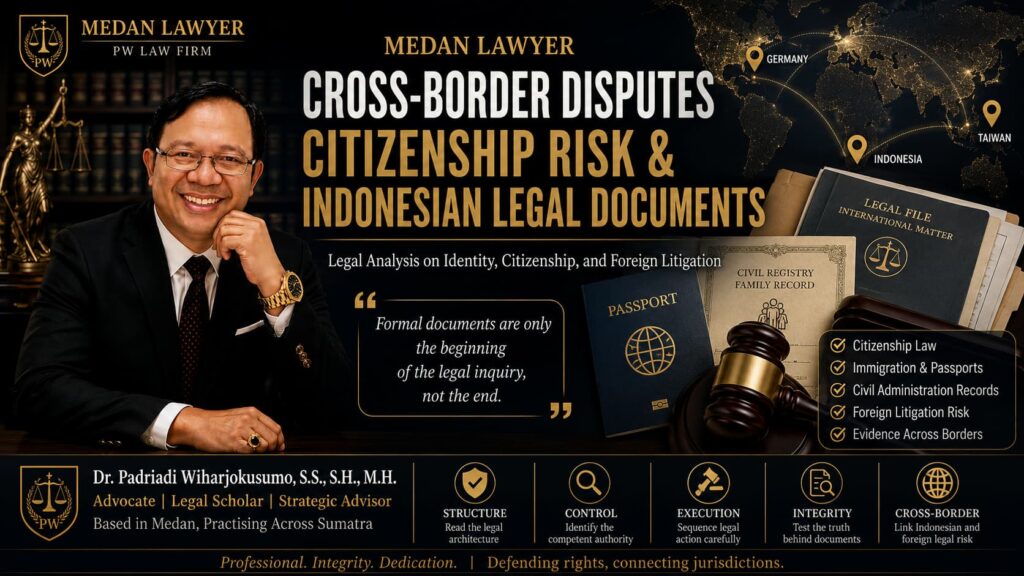
Cross-border dispute Indonesia: Cross-border disputes are rarely about one legal issue alone.
In practice, they often begin with a private conflict: a family dispute, a business disagreement, an inheritance claim, a contractual breakdown, or a contested ownership structure. But once the dispute crosses national borders, the legal problem changes. It is no longer only about who is right or wrong. It becomes a question of which legal identity is being used, which documents are being relied upon, and which jurisdiction has the authority to test the truth behind those documents.
This is where many cross-border disputes become structurally dangerous.
From the perspective of an Indonesian lawyer and legal academic based in Medan, cross-border litigation must be read through more than procedural law. It must be examined through citizenship law, immigration law, civil administration law, evidentiary rules, and the practical reality of how foreign courts understand Indonesian legal documents.
Dalam konteks ini, penting untuk memahami bahwa cross-border dispute Indonesia bukan hanya sekadar masalah hukum, tetapi juga melibatkan aspek sosial dan budaya yang kompleks.
At PW Law Firm Medan, we often approach complex legal problems not merely as isolated disputes, but as legal structures under pressure. A document may appear valid on its face. A passport may appear official. A family registry may appear administrative. But the deeper legal question is this: does the document reflect the legal truth, or does it merely create the appearance of legal certainty?
The Dialectical Problem: Formal Validity vs. Substantive Legal Truth
In the Padriadi Dialectical Method, every complex dispute must be read through tension.
The first layer is the thesis: a party presents official documents, such as a passport, family registration record, corporate document, or identity document. On paper, these documents appear formal, valid, and usable.
The second layer is the antithesis: another party challenges the factual and legal foundation of those documents. The challenge may involve citizenship status, dual nationality, false civil registration data, inconsistent identity records, or the use of documents in a foreign proceeding.
The third layer is the synthesis: the lawyer must reconstruct the legal structure by asking whether the documents are merely administrative records or whether they accurately reflect the person’s legal status under Indonesian law.
This is particularly important in disputes involving Indonesian citizenship. Under Indonesian law, citizenship is not only a personal status. It affects immigration rights, access to Indonesian documents, civil registration, property interests, litigation standing, and the use of Indonesian identity in domestic or foreign legal proceedings.
Indonesia’s citizenship framework is governed principally by Law No. 12 of 2006 on Citizenship of the Republic of Indonesia. One important legal issue under this framework is the consequence of voluntarily acquiring another nationality. This can raise serious questions where a person continues to use Indonesian identity documents after allegedly obtaining foreign citizenship.
When Indonesian Documents Enter Foreign Litigation
A cross-border dispute becomes more complicated when Indonesian documents are used before a foreign court.
A foreign court may see an Indonesian passport or civil registration document as evidence of identity or nationality. However, a foreign court may not automatically understand the internal legal consequences of Indonesian citizenship law, civil administration law, or immigration law.
This creates a legal gap.
For example, if a person uses an Indonesian passport in foreign litigation, the foreign court may treat that passport as proof of Indonesian nationality. But under Indonesian law, the deeper question may be whether that person was still legally entitled to hold or use such a passport at the relevant time.
This is why Indonesian legal analysis becomes critical.
The issue is not simply whether the passport exists. The issue is whether the legal status behind the passport remains valid.
Indonesian immigration law, including Law No. 6 of 2011 on Immigration, provides the broader legal framework for immigration documents, travel documents, and immigration administration. In a cross-border dispute, immigration documents may become central evidence, especially where one party relies on them to establish identity, nationality, or procedural standing in a foreign proceeding
Civil Administration Is Not a Minor Issue
Many people underestimate the importance of civil administration documents.
A family card, civil registry record, or identity data entry may appear to be routine paperwork. But in litigation, these records can become powerful legal instruments. They may be used to support claims about family status, nationality, domicile, lineage, inheritance, or legal capacity.
This is why civil administration data must be accurate.
Indonesia’s civil administration system is governed by the legal framework of population administration, including Law No. 24 of 2013, which amended Law No. 23 of 2006 on Population Administration. The integrity of civil administration data is not only a bureaucratic concern. It is part of legal certainty.
In cross-border disputes, inaccurate civil data can produce legal consequences beyond Indonesia. A document issued in Indonesia may be used abroad. A foreign court may rely on it. A private party may benefit from it. Another party may suffer loss because of it.
This is why Indonesian lawyers must be careful when reviewing cross-border disputes. The analysis cannot stop at the foreign case file. It must return to the Indonesian legal foundation: citizenship, immigration, civil registry, document issuance, and the legal consequences of administrative inconsistency.
For related Indonesian legal services, see our page on legal services in Medan and our discussion on business and corporate disputes in Medan.
The Lawyer’s Task: Not Emotion, But Structure
In sensitive disputes, especially those involving family, inheritance, nationality, or identity, emotion can easily dominate the narrative.
But legal work cannot be driven by emotion.
A lawyer must identify the structure.
First, what documents are being used?
Second, what legal status do those documents claim to represent?
Third, is there a contradiction between the documents and the person’s actual legal status?
Fourth, has the document been used in a way that causes legal or economic loss to another party?
Fifth, which institution has the authority to examine, correct, suspend, or revoke the relevant document?
This structural approach is essential because not every court has authority over every issue. A civil court may examine unlawful acts and damages. Immigration authorities may examine passport issuance and use. Civil registration authorities may examine population data. The Ministry of Law may examine citizenship matters. Criminal authorities may examine alleged falsification, false statements, or unlawful use of electronic evidence.
The role of counsel is to connect these channels without confusing them.
That is why PW Law Firm applies a structure-control-execution approach. Structure means identifying the legal architecture. Control means understanding which institution has legal authority. Execution means taking procedural steps in the correct sequence.
This approach is also reflected in our broader work on strategic legal advisory in Sumatra and foreign investment and dispute strategy in Indonesia.
Evidence Across Borders: Translation, Legalization, and Admissibility
A strong cross-border case depends on evidence.
But foreign evidence cannot simply be brought into an Indonesian legal process without preparation. Court decisions, official records, passports, company documents, and foreign registry materials may need sworn translation, legalization, or apostille treatment, depending on the country of origin and the intended legal use.
Indonesia has implemented apostille services through the Directorate General of General Legal Administration, and apostille verification is available through the official Apostille AHU platform. This is important for documents intended to circulate between jurisdictions that recognize the apostille system.
In practice, lawyers must ask:
Is the document original or certified?
Was it issued by a competent authority?
Does it need sworn translation?
Does it require apostille or legalization?
Can it be connected to the disputed legal act?
Will the court treat it as relevant and admissible?
These questions are not technical details. They can determine whether a cross-border case becomes persuasive or collapses at the evidentiary stage.
Why This Matters for Indonesia-Based Disputes
Medan and Sumatra are increasingly connected to international legal and commercial activity. Families have members abroad. Businesses use offshore entities. Investors operate through layered structures. Assets, documents, and legal proceedings may move between Indonesia, Singapore, Taiwan, Europe, and other jurisdictions.
This reality creates new legal risks.
A dispute that looks local may have foreign documents behind it. A foreign lawsuit may depend on Indonesian administrative records. A citizenship question may affect inheritance, property, or litigation standing. A passport may become more than a travel document; it may become a litigation instrument.
For this reason, Indonesian lawyers must be prepared to read cross-border disputes beyond the surface.
The real question is not only: “What document does the party hold?”
The deeper question is: “What legal truth does the document claim to represent, and can that truth survive legal examination?”
Conclusion: Cross-Border Litigation Requires Legal Discipline
Cross-border disputes require legal discipline, not assumptions.
When citizenship, identity, immigration documents, civil registration data, and foreign litigation intersect, the lawyer must move carefully. Public accusations should be avoided. Personal identities should be protected. The presumption of innocence must be respected. But legal questions must still be examined seriously.
A document may be official, but still legally contestable.
A passport may exist, but its legal foundation may require examination.
A foreign court may receive evidence, but Indonesian law may still determine whether the underlying identity or status is valid.
This is the core lesson of cross-border disputes involving Indonesian legal documents: formal documents are only the beginning of the legal inquiry, not the end.
At PW Law Firm, our approach is grounded in legal structure, institutional understanding, and practical litigation experience. As lawyers and legal academics based in Medan, we believe that complex disputes must be handled not only with procedural skill, but with the ability to see how law operates across borders, institutions, and real-world consequences.
About the Author
Dr. Padriadi Wiharjokusumo is an Indonesian advocate and legal academic based in Medan, North Sumatra. His work focuses on corporate law, cross-border investment, dispute strategy, economic crime, and legal risk structuring in Indonesia. Through PW Law Firm, he develops a hybrid legal approach that combines academic analysis, field experience, and strategic execution for complex disputes in Medan, Sumatra, and cross-border legal contexts.
Need a clear first step?
Send a brief summary of your case via WhatsApp, including your name, location, claim value or estimated value, chronology, and supporting documents.
Our team will conduct an initial review to better understand your legal issue.
Academic Disclaimer
This article is prepared as an academic legal analysis and professional legal insight based on publicly available legal principles, applicable statutory frameworks, and general references relevant at the time of writing.
The discussion does not intend to accuse, defame, or generalize any individual, institution, authority, or jurisdiction. All issues are discussed in an anonymized and educational manner, solely for the purpose of contributing to legal discourse on cross-border disputes, citizenship risk, document integrity, immigration administration, civil registration, and foreign litigation.
Any legal matter involving citizenship, immigration documents, civil administration records, or cross-border litigation must be assessed carefully based on its specific facts, documents, jurisdictional context, and applicable laws.
For specific legal advice, professional consultation should be sought from a qualified legal practitioner.